
.svg)



The Pressure on Healthcare Teams
Every patient request sets off a chain reaction.
A call to schedule an appointment.
A question about insurance coverage.
A request for follow-up care.
What appears simple on the surface quickly turns into a series of behind-the-scenes tasks. Information has to be collected. Schedules checked. Insurance verified. Patients routed to the right place.
Multiply that across hundreds, sometimes thousands, of interactions each week, the operational demand is relentless.
Individually, each task takes minutes. But together? Together, they can consume the entire workday.
The Growing Operational Burden
Most of this coordination still happens manually. Staff answer phones, gather details, move information between systems, and make sure each request lands in the right place.
For years, that model held together. But, like everything, healthcare has changed.
As UnityAI CEO and co-founder Edmund Jackson explained, “A lot of today’s pressure comes from ever-increasing complexity—regulations, payer requirements, patient volume, and technology that struggles to keep up.”
Each interaction now involves more steps, more verification, and more friction between systems that often don’t communicate well with each other.
The consequences show up immediately.
Response times slow. Administrative work expands, filling the day. Care teams spend more time navigating logistics and less time with patients. Over time, the pressure builds. As does the burnout risk.
So the question facing healthcare organizations is no longer just how to meet demand. It’s how to meet demand without overwhelming the people responsible for care.
A Different Way to Handle Demand
Imagine a healthcare organization receiving 10,000 patient calls in a week. Traditionally, the only way to keep up with that volume would be to add more staff.
But today, those 10,000 interactions can be absorbed without increasing headcount. Not by removing people from the system, but by shifting routine coordination to systems designed to manage it reliably.
If you look closely, you’ll see that most of the work is the same: answering common questions, collecting intake details, scheduling and confirming appointments, and directing patients to the appropriate next step.
These tasks are essential, but they are also high-volume, repeatable, and require little clinical judgment. And that reality opens the door to a different way of handling work.
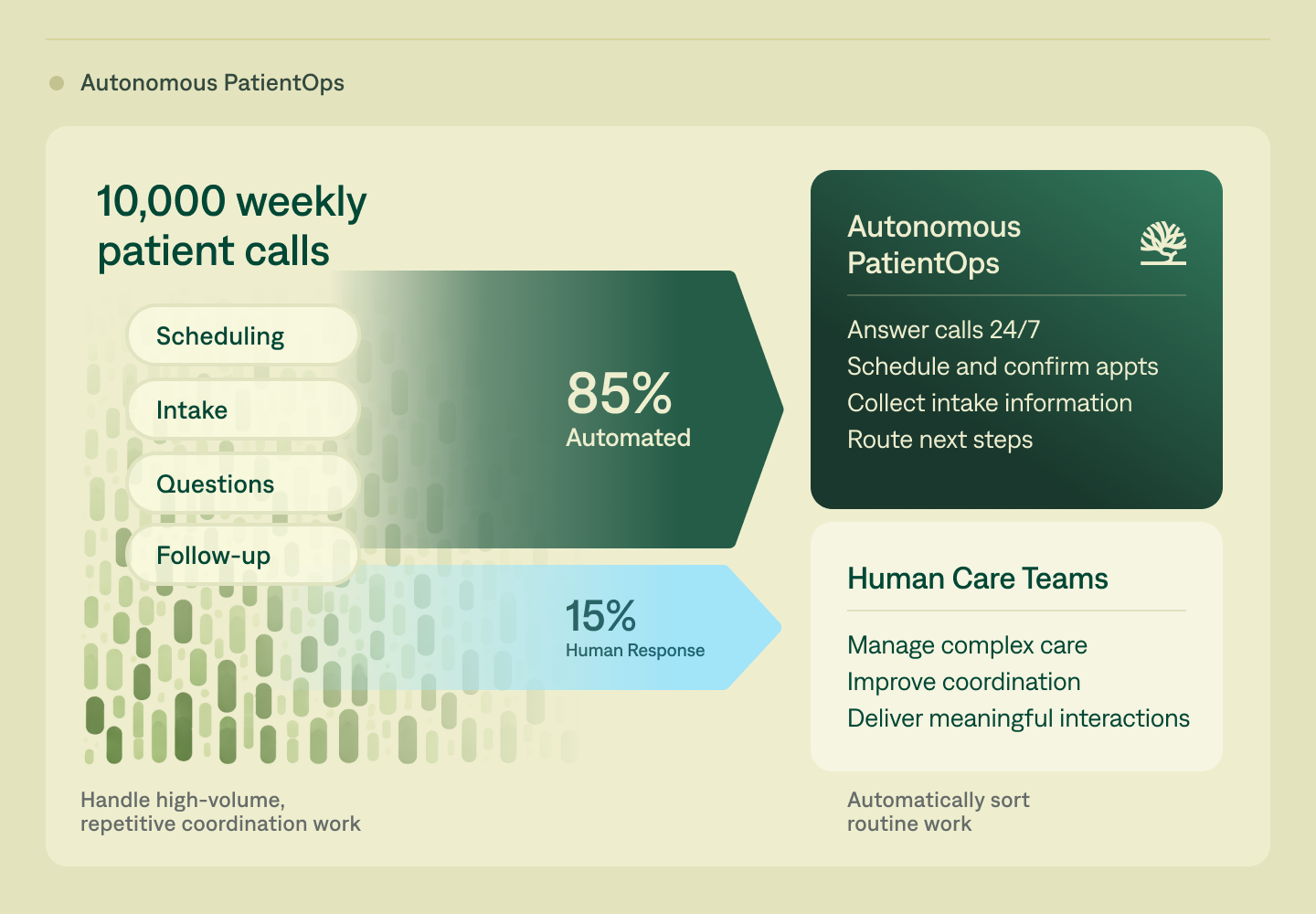
Organizations like UnityAI are enabling operational systems to handle this routine layer of work in the background. Instead of staff orchestrating every interaction from start to finish, these systems absorb the routine steps that slow everything down, while maintaining the same workflows teams use today.
When that happens, access starts to improve.
Fewer calls are missed. Scheduling moves faster. Bottlenecks ease. Patients reach care with less friction. And teams get something back they desperately need. Time.
And that’s the goal. Not to replace healthcare workers, but to return the hours currently consumed by administrative coordination. When systems absorb the routine flow of operational work, staff can focus on what truly requires human judgement—complex needs, care coordination, and meaningful patient interaction.
Doing more with less doesn’t have to mean pushing healthcare teams harder. It can mean designing operations that make space for the work of care.
UnityAI helps healthcare organizations automate operational coordination.
Reach out to learn more.