Pioneering patient experiences for highest-touch service
Patient Scheduling & Reminders
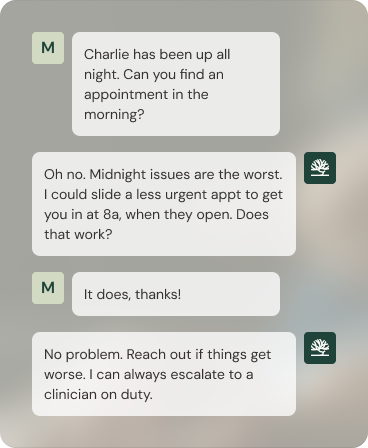
Let patients book, confirm, and reschedule easily, while auto reminders keep schedules tight and reduce gaps.
Patient Intake & Data Collection
Capture forms, consents, and key details before visits to speed up check-in and improve data accuracy.
Patient Outreach & Retention
Use timely nudges, follow‑ups, and education to keep patients engaged, on‑track, and returning.
Inbound Call Management
Triage and route calls efficiently to provide faster answers and reduce staff callbacks.
Insurance Verification & Eligibility
Verify coverage and benefits up front to prevent surprises and minimize claim denials.
Patient Financial Clearance
Share cost estimates and payment options early to improve transparency and accelerate collections.
Superhuman coordination for more nimble team management
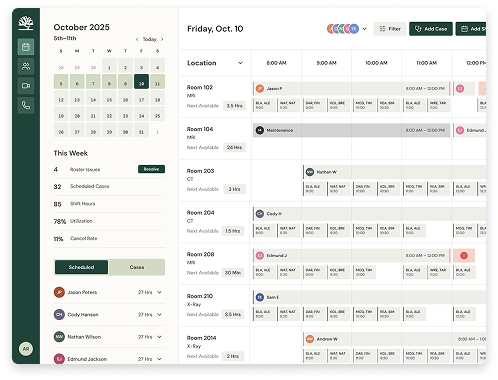
Staff Scheduling
Build and manage schedules to ensure the right people are in the right place at the right time.
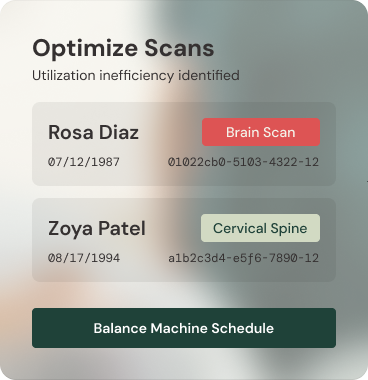
Staff Load Balancing
Balance workloads intelligently to keep capacity balanced and team and devices fully utilized.
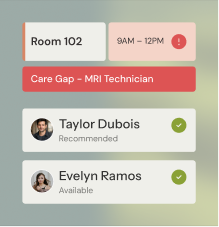
Real-Time Coverage Visibility
Surface real-time coverage insights to identify gaps across providers, rooms, and equipment.
Automated Shift Coverage
Fill open shifts quickly without manual back-and-forth and last-minute disruption.
Overtime & Shift Extension Requests
Handle overtime requests, approvals, and tracking to keep added coverage controlled and transparent.
Operational Notifications to Staff
Coordinate day-to-day operations without phone trees, inbox clutter, or missed messages.
Panoramic intelligence for continuous practice optimization
No-Show Probability Monitoring
Score the no-show risk of each visit and trigger targeted multi-channel outreach.
Smart Overbooking
Overbook only where historical data supports it, balancing provider load while keeping schedules at full capacity.
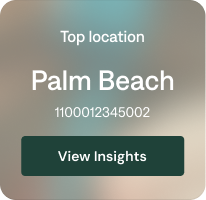
Location & Clinic Performance Optimization
Compare schedule performance across sites and clinicians to replicate what works and address what doesn't.
RCM Support
Support billing ops through insurance verification, benefit checks, and exception routing without replacing core systems.
Patient-to-New-Provider Flow
Proactively direct patients to new providers to help build their business and fill open schedules.
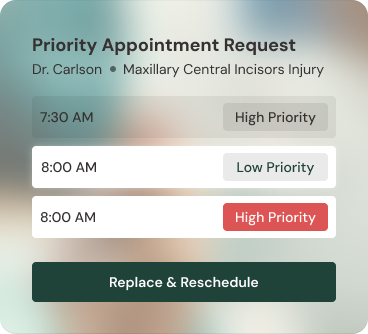
Event-Triggered Automatic Rebooking
Manage the downstream impact of unforeseen events like schedule changes, sick days, and clinic closures.
Enterprise Ready
Designed for health. Built for scale.
Extensible, API-driven infrastructure
We’re ready to adapt and scale alongside your company.
Built-in EHR and CRM integrations
UnityAI’s workforce works with your existing systems.
HIPAA and SOC2 compliant
Fully compliant from the ground up; full traceability.
IN THEIR WORDS
"We were up and running in less than 30 days, the fastest implementation we've ever had. The collaboration was seamless, and the ROI was clear from the start."
CEO, Behavioral Health Company
FAQ
Got questions? We’ve got answers.
From how our agents plug into your workflows to what implementation really looks like on the ground, we want to help you move from curiosity to confidence.
How is UnityAI different from lower-cost call centers or voice AI vendors?
Most lower-cost vendors are built for simple, transactional tasks — answering calls, routing requests, capturing basic information. UnityAI is built specifically for healthcare. It is designed to handle more complex workflows like scheduling, benefits verification, care coordination, and high-risk outreach — without constantly escalating to staff. That means fewer handoffs and less operational drag for your team. As volume grows, UnityAI continues resolving work end-to-end. That's why cost per minute isn't the metric that matters. What matters is whether the work actually gets done.
How do we know the AI will actually resolve work instead of just creating more follow-up?
UnityAI is built around workflow completion, not call completion. It confirms appointments, closes the loop on open tasks, detects incomplete work, and follows up automatically instead of sending tasks back to your team. Customers see results because UnityAI reduces downstream cleanup. It doesn't just absorb volume. It finishes the job.
How do you handle high-acuity or edge-case scenarios safely?
UnityAI operates within clearly defined guardrails and confidence thresholds. If a situation falls outside those boundaries, the work is automatically routed to staff — with full context and history attached. Nothing is guessed, dropped, or delayed. That's why UnityAI can support higher-acuity workflows where generic voice AI breaks down. It knows how to act and when to escalate.
What is the right way to roll out agentic AI without disrupting operations?
The best approach is progressive responsibility, not big-bang automation. UnityAI typically starts with contained, high-volume workflows where success is easy to measure. As accuracy and trust build, agents gradually take on more complex decisions and longer chains of work. This reduces operational risk while allowing organizations to expand impact over time.


















.svg)